Plastic Welding for Roofing & Waterproofing Membranes — A Civil & Roofing Contractor’s Guide
Introduction
Single-ply thermoplastic roofing membranes have become the standard waterproofing system on commercial roofs across New Zealand over the last twenty years. TPO, PVC, and FPO membranes are heat-welded at every seam — there are no glues, no sealants, no fasteners through the field of the roof, and no degradation of bond strength with age. A correctly welded seam is as strong as the parent membrane and as watertight as a piece of solid sheet.
This guide is for roofing contractors and civil installers responsible for membrane installation, repair, and certification. It covers the membrane types, the welding equipment, the field technique, the seam quality verification, and the common failure modes. Where relevant it links to the products and kits we supply to support this work.
If you’re new to plastic welding generally, read our How to Weld Plastics guide first. This article focuses specifically on membrane work.
The Membrane Materials
Roofing and waterproofing membranes in NZ fall into a small number of polymer families. Each has slightly different welding characteristics.
TPO (Thermoplastic Polyolefin)
TPO membranes are polypropylene-based with rubber modifiers and UV stabilisers. They’re the most-installed single-ply system on new commercial roofing in NZ — typically supplied in 1.2 mm or 1.5 mm thickness, white or grey, on rolls 2 m wide.
TPO welds in a relatively narrow temperature window — typically 400–460 °C from a hot air welder, depending on ambient temperature and substrate. Cold welds peel; overheated welds scorch. The acceptable window narrows further at low ambient temperatures, which is why winter roofing installs require careful temperature management.
TPO is what most NZ commercial roofers are welding day-to-day.
PVC (Polyvinyl Chloride) roofing membrane
Flexible PVC roofing membrane is the older single-ply system — still widely specified and reliable, particularly on retrofit work where compatibility with existing PVC details matters. Typical thickness 1.2 mm or 1.5 mm.
PVC welds at lower temperatures than TPO — typically 380–420 °C — and is more tolerant of variations in technique but more sensitive to the plasticiser content of the specific membrane. Older PVC membranes lose plasticiser over years in service and can become harder to weld for repairs.
PVC also releases small amounts of hydrochloric acid when overheated, so good ventilation matters when welding indoors or in confined spaces.
FPO (Flexible Polyolefin)
FPO is a polyolefin formulation similar to TPO but with different additive packages — sometimes positioned as a higher-spec alternative. Welding technique is essentially the same as TPO.
PEMD roofing membranes
PE-MD (Polyethylene Medium Density) roofing membranes are used in some specialist NZ applications — particularly where chemical resistance or specific flexibility characteristics are required. Welds with PEMD welding rod for repairs and details.
Bituminous and EPDM systems
Worth a brief note: EPDM rubber roofing is glued at seams, not heat-welded. EPDM is a thermoset, not a thermoplastic, so plastic welding tools don’t bond it. Bituminous (torch-on) systems are heat-applied but use bitumen, not thermoplastic welding — different equipment and technique.
The rest of this guide assumes you’re working with thermoplastic membranes (TPO, PVC, FPO, or PEMD).
The Equipment
Membrane welding uses essentially the same equipment family as fabric welding, with two main classes of welder plus a small number of consumable accessories.
Automatic overlap welders
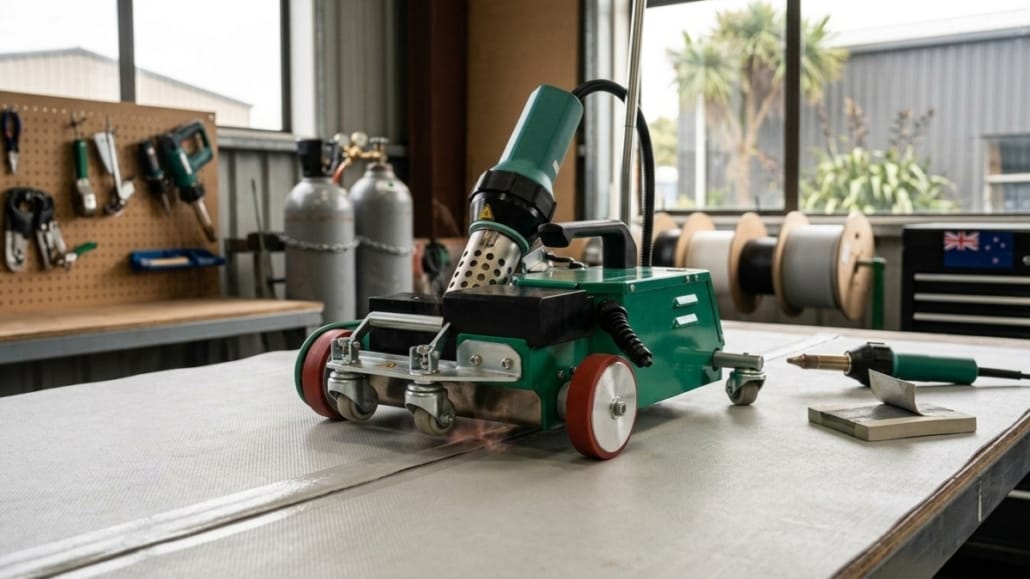
The main field seam welder. Once the roll is positioned and the membrane is overlapped along the seam line, an automatic overlap welder is set down at the start of the seam, started, and walks itself along the joint at a controlled travel speed. Hot air softens the inside faces of both membrane layers; pressure rollers immediately behind the heating nozzle squeeze the molten surfaces together.
Key specifications when buying:
– Power output — typically 4–6 kW for commercial roofing duty
– Travel speed range — usually adjustable from very slow (for thick or cold-weather installs) to fast (for warm, thin material)
– Pressure roller width — typically 20–40 mm, matched to the desired weld track width
– Temperature stability — important for consistent welds across long days
The Techspan Roofon series is widely used on NZ commercial roofing for this duty.
Hand hot air welders
The detail welder. A hand hot air welder handles all the work the automatic can’t reach: corners, edge terminations, drains and other penetrations, perimeter details, and any repair work after initial installation.
For TPO and PVC membrane work specifically, the welder needs:
– Adequate power (1.6–2.0 kW for handheld, more for some specialised tools)
– A flat nozzle (typically 20 mm or 40 mm wide) for membrane work
– Stable temperature control
– Comfortable ergonomics for hours of overhead and awkward-angle work
The Techspan Rion2 series is well suited to this work.
Pressure rollers
Critical for hand welding. After heating the seam with the hot air tool, the molten faces are pressed together with a hand-held pressure roller — typically a 40 mm silicone roller for general work, with a seam-probe variant used during quality testing.
We supply pressure rollers in silicone (40 mm and 80 mm), PTFE (40 mm), and brass penny rollers for membrane probing.
Seam test equipment
The dual benefit of welded seams is that they can be non-destructively tested. Common test equipment:
– Air pressure test device with needle — for testing dual-track seams produced by hot wedge welders or pre-formed air channels
– Pull testers and tension meters — for destructive sample testing during commissioning
– Penny roller / seam probe — manual mechanical inspection of every metre of completed seam
See our weld testing equipment range for current options.
Hot wedge welders
For specifications that require dual-track pressure-testable seams — particularly larger commercial roofs and any roof under a specific QA regime — a hot wedge welder is the right primary tool. The dual-track seam includes an integral air channel that can be inflated and pressure-tested after welding.
Roofing-specific kits
We assemble roofing kits that match an automatic overlap welder, hand welder, pressure rollers, penny rollers, seam probes, and basic test equipment to a typical contractor’s set-up.
Field Technique: From Roll to Welded Seam
The process of laying down a TPO or PVC membrane roof has a rhythm that’s worth understanding even if you’re not the one operating the tools.
Substrate preparation
The deck has been prepared by others — typically insulation board fastened to the deck or adhered. Membrane is rolled out from the high end of the roof toward the drains, with each successive roll overlapping the previous one by the specified amount (usually 60–80 mm). Edges are aligned with the rolls, fasteners are placed at the upper edge in the lap zone, and the membrane is loose-laid ready for welding.
The seam line — where the two layers overlap — is where all the welding happens.
Setting up the automatic welder
Before starting any seam:
- Wait for the welder to reach temperature. Most machines need 5–10 minutes from cold to stable operating temperature.
- Run a test weld on offcut material from the same roll. Set up the welder at the suggested temperature and travel speed for the material and ambient conditions.
- Pull-test the test weld. A correctly welded seam will tear into the parent material when pulled — the weld itself doesn’t fail. If you can peel the test weld apart cleanly, the temperature or speed is wrong. Adjust and re-test.
- Record the settings that produced the good test weld. Use them as the baseline for the day’s work, adjusting only if conditions change (ambient temperature, wind, material from a different roll).
Running the seam
With the welder set up:
- Position the machine at the start of the seam with the nozzle correctly inserted between the two membrane layers.
- Start the drive. The welder walks itself along the seam at the set speed.
- Watch the seam at the back of the welder. A good weld shows a small bead of softened material extruded along each edge of the pressure roller track — a visual confirmation that the membrane reached fusion temperature.
- Stop the machine at the end of the seam, allow it to cool, and reposition for the next seam.
Detail work
After the field seams are run with the automatic, the hand welder handles everything else:
- Roll endings — where one roll ends and another begins, the automatic can’t complete the last few inches. Hand-finish.
- T-joints — where three membrane edges meet at a corner.
- Drain and penetration boots — pre-formed corner pieces or field-fabricated patches around vent stacks, drains, skylights, conduits.
- Edge terminations — where the membrane stops at a parapet, wall, or edge metal.
- Patches — repairs to damaged sections, foreign objects punctured through after install.
All of this is hand welding with a flat nozzle, immediately followed by pressure rolling.
Temperature, Speed, and Pressure — The Three Variables
Almost every membrane welding decision comes down to balancing three variables.
Temperature
The welder’s air temperature setting. Too low, and the membrane doesn’t reach fusion — the weld peels. Too high, and the membrane is degraded — the weld scorches or burns through.
For TPO: typically 400–460 °C at the welder.
For PVC: typically 380–420 °C.
For PEMD: typically 380–420 °C.
These are starting points. The actual ideal varies with ambient conditions, material thickness, and travel speed.
Travel speed
How fast the welder moves along the seam. Slower travel means more heat into the joint; faster travel means less heat. Travel speed compensates for temperature within limits.
Typical TPO travel speeds: 1.5–3.5 m/minute for automatic welders. Hand welding is much slower — typically 200–400 mm/minute depending on detail complexity.
Pressure
The downward force on the pressure rollers (automatic) or the operator’s hand-held roller force (manual). Higher pressure forces the molten faces into closer contact and produces denser welds.
Pressure is the most consistent variable on an automatic welder — set once, leaves alone. On hand welding, operator-applied pressure varies and is the most common source of inconsistent welds.
Compensating for ambient conditions
Cold weather: lower ambient temperature means the membrane loses heat faster after the welder passes. Compensate by increasing temperature slightly, slowing travel speed, or both. Below about 5 °C ambient, welding becomes unreliable and most spec sheets call for cessation of work.
Hot weather: the membrane is already warm when the welder arrives. Compensate by reducing temperature or increasing travel speed slightly. Membrane sitting in direct sun at midday is very different from membrane in shade.
Wet conditions: moisture on the membrane surface flashes to steam during welding, producing porous welds. Do not weld in rain or on wet membrane. After overnight dew, allow the membrane to dry before starting work.
Wind: high wind can disturb the hot air stream from the welder. Wind shields are sometimes used; very high wind is grounds to stop work.
Seam Quality Verification
A weld that looks right and a weld that is right are not always the same. Field quality verification is what separates competent membrane installation from problem roofs.
Visual inspection
Walk every metre of completed seam. Look for:
– A small extruded bead along the edge of the seam — confirms fusion temperature was reached
– No discolouration or scorching — confirms temperature wasn’t too high
– No skips where the welder lost track or paused
– Proper overlap dimensions — measured at random points
Probe testing
A blunt metal probe (typically a brass-tipped tool) is pushed along the edge of every seam after welding. Anywhere the probe penetrates is an unfused area. The penny roller doubles as a probe — its rolling action exposes any unfused edges.
This is mandatory on most commercial specifications. Every linear metre of seam gets probed.
Air pressure testing (dual-track seams)
For hot-wedge dual-track seams, the air channel between the two weld tracks is inflated through a needle valve and held at pressure for a specified time (typically 250 kPa for 5 minutes per metre of seam). Pressure drop indicates a leak somewhere along the air channel.
The air pressure test device with needle is the tool for this.
Destructive sample testing
For commissioning of major projects, samples are sometimes cut from non-critical areas and tested in a tensile tester. The failure mode is what matters: the weld should not be the weakest part of the sample. If the sample fails in the parent membrane and the weld holds, the weld is sound.
Handy tensionmeters are field-portable for this kind of test.
Common Failure Modes
Most membrane roof failures are seam failures, and most seam failures trace back to a small number of root causes.
Cold weld (insufficient fusion). Weld peels cleanly when probed. Temperature was too low, travel speed too fast, or the membrane was wet/cold. Visible by probing — invisible from above. Compensate immediately and re-weld the affected section.
Scorched weld (over-heating). Visible discolouration or scorching of the membrane along the seam. The membrane is degraded and brittle along the weld zone — even if the weld bond appears strong now, it’ll fail under thermal cycling within months. Cut out and replace.
Skip welds. The welder lost track or paused, leaving an unfused section in the middle of an otherwise good seam. Common after the operator stops to adjust something mid-run. Probe every metre and re-weld any skips.
Contamination. Mud, oil, footprint dirt trapped between the two membrane layers prevents fusion at that point. Spot-weld failures around obvious contamination points are usually this. Prevention is the only fix — keep the seam line clean during install.
Wrong material weld attempt. Trying to weld TPO to PVC, or older PVC roof to new TPO patch. The materials don’t bond. Identify the existing membrane correctly before welding any patch or repair.
Roof traffic damage. Foreign objects walked into the membrane during install or service work. Punctures don’t self-heal — they need to be patched.
Repairs and Patching
Most contractors do as much repair work as new install. The process for a typical patch:
- Identify the membrane type. If it’s not your install, find out before you commit. TPO, PVC, FPO, and PEMD all need different patches.
- Source matching membrane material. Same family, similar thickness and colour. Off-cuts from current rolls are ideal; otherwise from the original manufacturer.
- Clean the area around the damage. Remove dirt, debris, ponded water residue, and any loose material.
- Cut a patch that overlaps the damaged area by at least 75 mm on every side. Round corners on the patch.
- Round corners on the damaged area too if there’s an L-shape or T-cut — sharp corners are stress concentrators.
- Hand-weld the patch in place using a flat nozzle and pressure roller, following the same technique as field detail work.
- Probe-test the seam all the way around the patch.
For larger repairs — multi-metre sections, ponded water damage, drainage failure — the process is the same but the material handling is more involved.
Getting Started in Membrane Welding
If you’re a roofing contractor stepping into single-ply membrane work for the first time:
- Start with the right kit. Our roofing kits match an automatic overlap welder, hand welder, pressure rollers, and basic accessories to a contractor’s starting setup.
- Get training. Most manufacturers run installer certification programs. We can point you to current training providers in NZ.
- Practice on offcuts before going on the roof. A few hours of bench-testing develops the eye for what a good weld looks like.
- Always run a test weld on the day. Conditions vary — yesterday’s settings may not be today’s settings.
For specification advice on a particular project, equipment sizing, or training options, get in touch with our team. Plastic Welding Tools NZ has been supplying the New Zealand trade since 2013 — we know the membrane systems, the contractors, and the certification requirements.
Related Reading
- How to Weld Plastics — the foundational plastic welding guide
- Which Plastic Welding Method Is Right for You? — hand vs automatic vs extrusion comparison
- Plastic Welding Rod Guide — matching rod to material
- Welding Industrial Fabrics — applications outside roofing
- Automatic welders and hand welders product ranges

