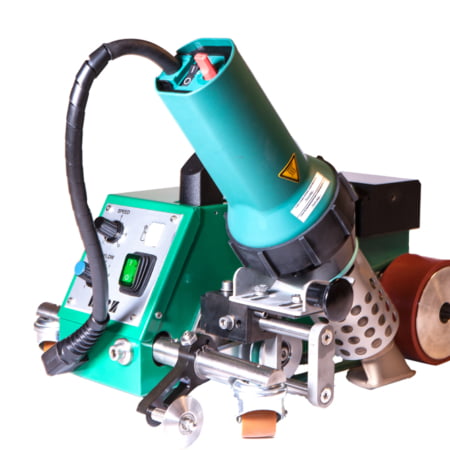
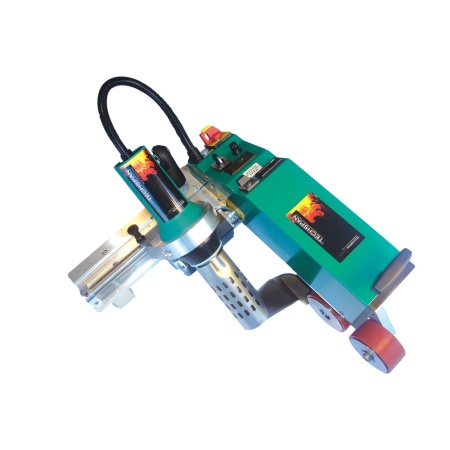
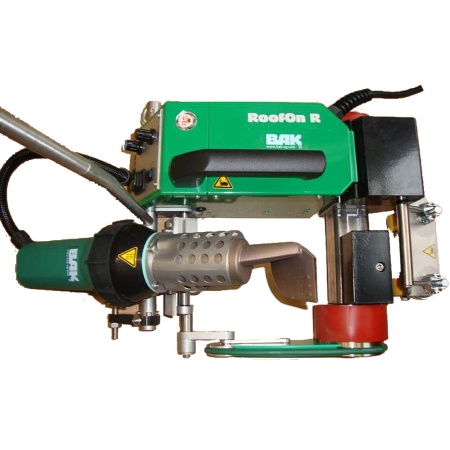
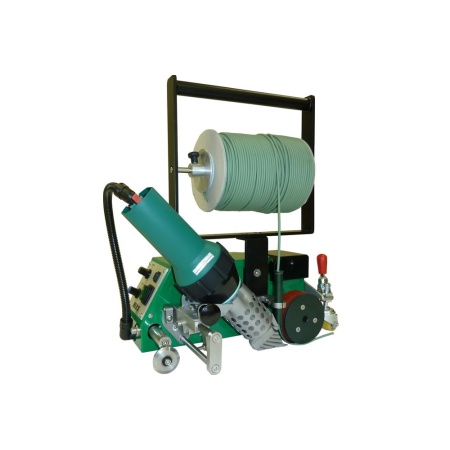
Automatic plastic welders take the operator out of the seam and onto the controls. Where hand welding relies on the welder’s feel for heat and speed, an automatic welder runs at a calibrated temperature, pressure and speed along the seam, producing consistent, repeatable, structurally-sound welds — the kind required for landfill liners, roofing membranes, pond liners, tank baffles and industrial tarpaulin manufacturing.
The Plastic Welding Tools NZ range covers two main automatic-welder types:
Overlap welders (hot-air) — the Laron, Comon, Mion-Pro and similar machines use a stream of hot air directed between two layers of fabric or membrane while a drive wheel pulls the seam through and a pressure roller compresses the molten layers together. Ideal for PVC tarps, PE pond and landfill liners, and PVC awnings.
Wedge welders (hot-shoe) — a heated metal wedge contacts both layers as they pass through, fusing the seam under pressure. The Comon, Mion-Pro and similar wedge welders are common on roofing-membrane and heavy-tarpaulin work where higher temperatures and thicker materials are involved.
Available in 230 V single-phase machines for general fabrication and 400 V three-phase machines for high-output industrial production. Drive speed is variable, temperature is digitally controlled, and pressure is adjustable for the material being welded.
These machines are supported in New Zealand with local spares (heating wedges, carbon brushes, drive wheels) available. For an introduction to the applications, see welding clear PVC cafe blinds and awnings or industrial fabric welding.
About Automatic Welders
Automatic plastic welders take the operator out of the seam and onto the controls. Where hand welding relies on the welder’s feel for heat and speed, an automatic welder runs at a calibrated temperature, pressure and speed along the seam, producing consistent, repeatable, structurally-sound welds — the kind required for landfill liners, roofing membranes, pond liners, tank baffles and industrial tarpaulin manufacturing.
The Plastic Welding Tools NZ range covers two main automatic-welder types:
Overlap welders (hot-air) — the Laron, Comon, Mion-Pro and similar machines use a stream of hot air directed between two layers of fabric or membrane while a drive wheel pulls the seam through and a pressure roller compresses the molten layers together. Ideal for PVC tarps, PE pond and landfill liners, and PVC awnings.
Wedge welders (hot-shoe) — a heated metal wedge contacts both layers as they pass through, fusing the seam under pressure. The Comon, Mion-Pro and similar wedge welders are common on roofing-membrane and heavy-tarpaulin work where higher temperatures and thicker materials are involved.
Available in 230 V single-phase machines for general fabrication and 400 V three-phase machines for high-output industrial production. Drive speed is variable, temperature is digitally controlled, and pressure is adjustable for the material being welded.
These machines are supported in New Zealand with local spares (heating wedges, carbon brushes, drive wheels) available. For an introduction to the applications, see welding clear PVC cafe blinds and awnings or industrial fabric welding.
Overlap welders versus wedge welders
Automatic welders take the operator's feel out of the seam. The temperature, pressure and drive speed are all set on the machine, so every metre of seam is welded to the same specification — exactly what's required for landfill liners, roofing membranes, pond liners and industrial tarpaulin manufacturing.
Overlap welders (hot-air)
A hot-air stream is directed between two overlapping layers of fabric or membrane. A drive wheel pulls the seam through and a pressure roller compresses the molten layers together. Best for:
- PVC tarps and awnings
- PE pond and landfill liners
- PVC cafe blinds and clear awnings
- Banner and signage fabric welding
Wedge welders (hot-shoe)
A heated metal wedge contacts both layers as they pass through, fusing the seam under pressure. The double-track weld (two parallel seams with a test channel between) allows non-destructive air-pressure testing. Best for:
- Roofing membrane (TPO, PVC, EPDM)
- Heavy tarpaulin and industrial cover work
- Landfill liner with QA-grade seam verification
- Geomembrane fabrication
Power requirements
Most overlap welders run on 230V single-phase NZ power and are suited to general workshop fabrication. The higher-output industrial machines — particularly those designed for full-day production runs — require 400V three-phase. Check the power available at your site before ordering.
| Machine type | Voltage | Typical output | Best for |
|---|
| Laron 21 overlap welder (40mm) | 400V three-phase | Industrial | Production PVC and PE membrane fabrication |
| Laron 21 overlap welder (80mm) | 400V three-phase | Industrial | Wide-seam PVC and PE membrane fabrication |
| Comon wedge welder | 230V single-phase | Workshop | Tarpaulin, banner and roofing membrane work |
| Mion-Pro wedge welder | 230V single-phase | Workshop | General membrane and heavy tarpaulin welding |
| Flooron flooring welder | 230V single-phase | Workshop | Vinyl and PVC flooring seam welding |
Quality control on automatic welds
For structural, food-grade or waterproof-membrane fabrications, every seam should be verified. Air-pressure testing for wedge-welded membranes, tensile peel testing on coupon samples for general fabric welds. See our weld testing equipment range for the QA tools fabricators use.
Frequently asked questions
What's the difference between an overlap welder and a wedge welder?
An overlap welder uses a stream of hot air directed between two overlapping layers of material while a drive wheel pulls the seam through; a pressure roller compresses the molten layers together. A wedge welder uses a heated metal wedge that contacts both layers as they pass through, fusing them under pressure. Overlap welders are ideal for PVC tarps, PE pond and landfill liners, and PVC awnings. Wedge welders are common for roofing membranes and heavy tarpaulin work.
Do I need 230V single-phase or 400V three-phase?
For general workshop fabrication and most repair work, 230V single-phase is sufficient. For high-output production fabrication where the machine runs for hours continuously, 400V three-phase delivers more sustained power and is often the industrial standard. Check what power is available at your site before ordering.
How fast can an automatic welder run?
Drive speed is variable — typically 0.5 to 6 metres per minute on most machines. The right speed depends on the material thickness, the welder temperature setting, and the seam type. Slower passes give stronger welds; faster passes are economical when the parameters are well-tuned. Always do a test weld on offcut material before starting a production run.
How do I test the strength of an automatic-welder seam?
For roofing membrane and pond/landfill liner fabrication, the standard non-destructive test is air-pressure testing the double-track wedge weld. For tarpaulin and general fabric welding, tensile (peel) testing of a sample coupon against the parent material is the most common QA approach. Spark testing is used on tank linings where leak integrity matters. See our weld testing equipment range.
Can the same machine weld PVC tarps and HDPE landfill liner?
Yes, with parameter adjustments. The same overlap welder can weld both, but the temperature, pressure and speed are quite different for each material. PVC welds at lower temperatures and lower pressure; HDPE needs higher temperature and more pressure. Many production fabricators run separate machines tuned to each material rather than re-tuning between jobs.
What spares should I keep on hand?
For overlap welders: heating element, carbon brushes, drive wheel, and a spare pressure roller. For wedge welders: replacement heating wedge, drive belt, and brushes. Heating elements are the most common service item — they wear with use and have a finite life. Keep a spare on hand to avoid downtime mid-production.
Need help choosing the right automatic welder?
Tell us about the job: the plastic you're working with, the wall thickness, and how often you'll use the tool. We'll recommend the right kit, welder or accessory for the application.
Get a recommendation Call us