Industrial Hot Air Blowers: Choosing the Right Tool for NZ Trade
Why Hot Air Blowers Are Essential for NZ Trade
Hot air tools are indispensable across industries like plastic fabrication, geomembrane installation, and automotive repair. They weld plastics, shrink films, dry components, activate adhesives, and strip coatings — all with precise, controllable heat. Choosing the right industrial hot air blower ensures clean, repeatable results, while the wrong choice can lead to underpowered airflow or overheating.
This guide explains the types of hot air blowers, how to size them, and the range available from Plastic Welding Tools NZ.
Handheld Tools vs Stationary Blowers
Industrial hot air equipment falls into two categories:
- Handheld hot air tools — Portable units for manual tasks like plastic welding, shrinking, and bending. Power ranges from compact 0.8 kW tools to heavy-duty 9–17 kW models.
- Stationary blowers and heaters — Bench-mounted units for continuous, high-volume air streams in production lines, drying, and automated processes. Often paired with separate air-supply blowers.
Decide whether your application requires manual control or continuous process heat before selecting a tool.
Handheld Hot Air Tools
For manual plastic welding and heating, handheld tools are ideal. The range includes:
- Light-duty (0.8–1.5 kW) — Perfect for detailed work, small welds, and tight spaces.
- General-purpose (2–4 kW) — The workhorse for most plastic welding and shrinking tasks.
- Heavy-duty (5–17 kW) — High-output tools for large-area heating and demanding production.
Features like brushless motors (e.g., Techspan Eron BL) offer longer service life and lower maintenance. Closed-loop temperature control ensures consistent results.
Stationary Blowers & Hot-Air Heaters
For automated or continuous processes, stationary equipment provides the volume and consistency handheld tools cannot:
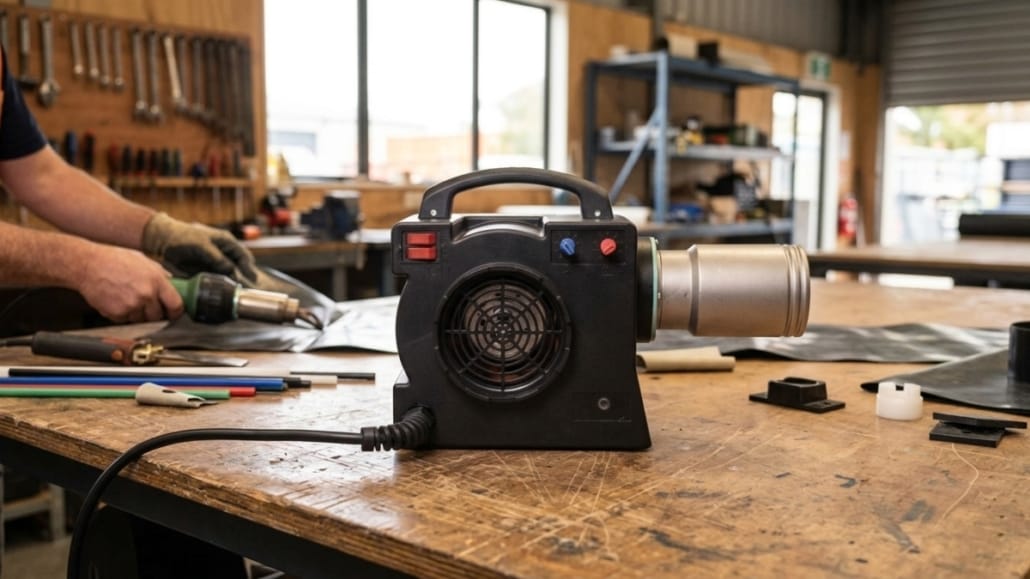
- Compact Hot Air Blower — Delivers steady hot air for drying, shrinking, and pre-heating.
- Air Station Blowers — Supplies air streams for heaters and hot air tools.
- HD / MD Blowers — Side-channel blowers for high-pressure or high-volume air supply.
How to Choose the Right Hot Air Blower
Match the tool to your process, not just its wattage:
- Power (kW) — Determines air temperature and heating capacity.
- Airflow (l/min or m³/h) — High volume for large areas; focused flow for precise welding.
- Temperature control — Adjustable, stabilised temperature is critical for consistent welds and heat-sensitive materials.
- Duty cycle — Continuous production requires brushless motors for long runs.
- Air supply — Check if the unit is self-contained or requires an external blower.
Applications for Hot Air Blowers
Hot air blowers are used for:
- Plastic and geomembrane welding
- Heat-shrink film and sleeving
- Drying and pre-heating components
- Activating hot-melt adhesives
- Paint and coating removal
- Shrink-fitting
If you’re welding plastics, explore our guides on plastic welding methods and how to weld plastics.
Find the Right Tool for Your Job
Choosing the right blower depends on your material, throughput, and whether the work is manual or automated. Browse the full industrial heaters & blowers range, or contact our team for expert advice. We supply trade and industry across New Zealand.
